Sharaku: The actor Segawa Ichimatsu III in the role of Onayo. 1794: The actor Segawa Ichimatsu III in the role of Onayo. 1794
Sharaku Coloring Page
Social Connections & Human Relations: Dr. Jennifer Golbeck
Posted in Mental Health, Research, Social Media, youtube
Tagged media, research, social, youtube
Leave a comment

Tidy desk or messy desk?
Working at a clean and prim desk may promote healthy eating, generosity, and conventionality, according to new research. But, the research also shows that a messy desk may confer its own benefits, promoting creative thinking and stimulating new ideas.
The new studies, conducted by psychological scientist Kathleen Vohs and her fellow researchers at the University of Minnesota are published in Psychological Science, a journal of the Association for Psychological Science.
“Prior work has found that a clean setting leads people to do good things: Not engage in crime, not litter, and show more generosity,” Vohs explains. “We found, however, that you can get really valuable outcomes from being in a messy setting.”
In the first of several experiments, participants were asked to fill out some questionnaires in an office. Some completed the task in a clean and orderly office, while others did so in an unkempt one — papers were strewn about, and office supplies were cluttered here and there.
Afterward, the participants were presented with the opportunity to donate to a charity, and they were allowed to take a snack of chocolate or an apple on their way out.
Being in a clean room seemed to encourage people to do what was expected of them, Vohs explains. Compared with participants in the messy room, they donated more of their own money to charity and were more likely to choose the apple over the candy bar.
But the researchers hypothesized that messiness might have its virtues as well. In another experiment, participants were asked to come up with new uses for ping pong balls.
Overall, participants in the messy room generated the same number of ideas for new uses as their clean-room counterparts. But their ideas were rated as more interesting and creative when evaluated by impartial judges.
“Being in a messy room led to something that firms, industries, and societies want more of: Creativity,” says Vohs.
The researchers also found that when participants were given a choice between a new product and an established one, those in the messy room were more likely to prefer the novel one — a signal that being in a disorderly environment stimulates a release from conventionality. Whereas participants in a tidy room preferred the established product over the new one.
“Disorderly environments seem to inspire breaking free of tradition, which can produce fresh insights,” Vohs concludes. “Orderly environments, in contrast, encourage convention and playing it safe.”
Surprisingly, the specific physical location didn’t seem to matter: “We used 6 different locations in our paper — the specifics of the rooms were not important. Just making that environment tidy or unkempt made a whopping difference in people’s behavior,” says Vohs.
The researchers are continuing to investigate whether these effects might even transfer to a virtual environment: the Internet. Preliminary findings suggest that the tidiness of a webpage predicts the same kind of behaviors.
These preliminary data, coupled with the findings just published, are especially intriguing because of their broad relevance:
“We are all exposed to various kinds of settings, such as in our office space, our homes, our cars, even on the Internet,” Vohs observes. “Whether you have control over the tidiness of the environment or not, you are exposed to it and our research shows it can affect you.”
Co-authors on this research include Joseph Redden and Ryan Rahinel of the University of Minnesota. Redden discusses the new research in this video from the Carlson School of Management of the University of Minnesota.
K. D. Vohs, J. P. Redden, R. Rahinel. Physical Order Produces Healthy Choices, Generosity, and Conventionality, Whereas Disorder Produces Creativity. Psychological Science, 2013
Posted in creative arts therapy, lifespan, Self expression
1 Comment

Therapy cards
One Creative Arts Therapy Tool that I use is to paint. Some times  pictures of actual ‘things’ like trees or boats; but I usually paint shapes. Lately I have been using water colors to paint shades and gradients of color. Colors shifting from one type of purple(for instance) to a deeper purple.
There is a lot going on in the simple act of painting color that involves cognitive processes, emotional expression, mindfulness practice, amongst others. There is the hand eye coordination, and the movement of the body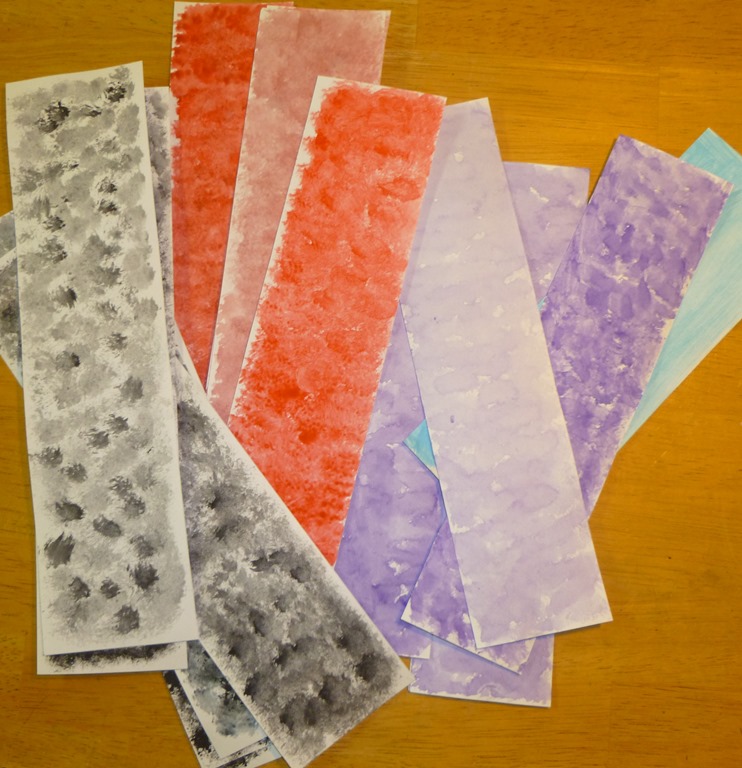 (hand,arm shoulder), to apply the paint to the brush, water and paper. There is the picking and choosing of colors that I want to use; sometimes I pick a color that has a pleasing effect on how I feel, and sometimes that choice changes how I feel. The act of painting requires focus and at least a little concentration being in the here and now.
I have been turning my gradient paintings into therapy cards. I work a lot with groups providing therapy and often participants have difficulty expressing their feelings and/or thoughts. The cards provide an avenue for people to share/start a conversation. I have created affirmation cards, feelings cards, drama therapy cards, movement cards, yoga asana cards, and many others.