
The Power of Compliments
Posted in Compliments, Emotions, Grounding, Wellness
Tagged emotional expression, wellbeing, wellness
Leave a comment
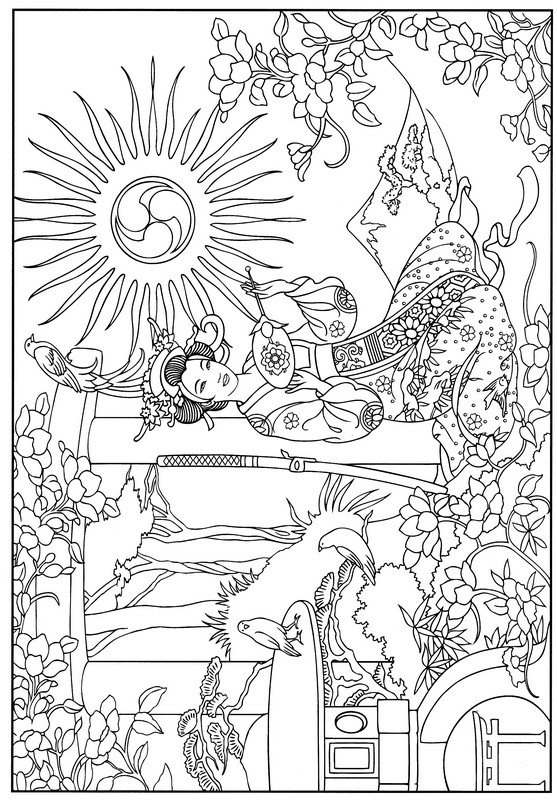
Amaterasu Coloring Page
Amaterasu, Amaterasu-ōmikami or Ōhirume-no-muchi-no-kami is a part of the Japanese myth cycle and also a major deity of the Shinto religion. She is seen as the goddess of the sun, but also of the universe. The name Amaterasu derived from Amateru meaning “shining in heaven.” The meaning of her whole name,Amaterasu-ōmikami, is “the great august kami (god) who shines in the heaven”.
https://en.wikipedia.org/wiki/Amaterasu
Faith, psychotherapy link
Whether or not it’s the legacy of Sigmund Freud, the religiously skeptical founder of psychoanalysis, there’s often a disparity in the counseling room.
Psychiatrists are less likely to claim a religious affiliation or to practice religion than other doctors, or the general public from whom their clients come, according to research.
An upcoming conference, “When God Talks Back: Psychotherapy and the Faithful,” aims to bridge that gap by helping mental-health professionals understand their clients’ spiritual experiences.
Keynote speaker T.M. Luhrmann, a psychiatric anthropologist and professor of anthropology at Stanford University, will speak at the April 28 conference at the Frick Fine Arts Building Auditorium at the University of Pittsburgh. 
Ms. Luhrmann will discuss her research into how evangelical Christians perceive their relationship with God — and how in many ways their religious experience provides the same reinforcement that psychotherapy does.
“You can make the argument that psychoanalysis is a secular attempt to deal with some of the existential issues that earlier were managed within religion,” said Ms. Luhrmann, who has a doctorate from Cambridge University.
“We know that going to church is good for you, and increasingly we know there are health benefits associated with prayer,” she said. Part of that, she said, may be that religious people simply are more likely to have social support through their congregations and avoid destructive behaviors.
“But the evidence is also emerging that there’s something about the quality of maintaining a relationship with the God who loves you and the transformative benefits of seeking an experiencing of God that have a positive impact on your emotional well-being and possibly physically,” she said.
Often in prayer, she said, evangelical believers give thanks for their blessings, confess sins and resolve to mend their ways, and emerge feeling reinforced in their belief in a God they perceive as “loving and merciful rather than judgmental.”
She said that experience is similar to what happens in cognitive behavioral therapy — in which a patient is guided into “shifting attention from what’s going wrong to what’s going right,” and finding the strength and imagination to see themselves pulling out of destructive patterns.
“It reorganizes the way you think,” she said.
Ms. Luhrmann’s 2012 book, “When God Talks Back,” has won widespread recognition, being named a New York Times Notable Book of the Year and winning the Louisville Grawemeyer Award in Religion.
An organizer of the conference, Jon Spiegel, clinical assistant professor of psychiatry at the University of Pittsburgh, said Ms. Luhrmann’s talk will be important to “understand what the evangelicals are up to in a psychologically sophisticated way so that the health-care professionals can do a better job with their patients.”
Sponsors include the Western Psychiatric Institute and Clinic of UPMC, Westminster Presbyterian Church, Pittsburgh Pastoral Institute, Jewish Family and Children’s Services and Community Care Behavioral Health Organization.

Creative Movement & Management
Could managers gain a new kind of understanding about their interaction with colleagues and employees by ‘dancing’? That’s the question arising from new research. Management is usually considered a stiff and rational business, decisions made based on fiscal studies, profit margins and market forces. However, researchers have studied whether creative movement (‘dance’) might improve a manager’s awareness concerning their management interaction.
The team encouraged volunteers to “dance their feelings” and videotaped them so that hidden insights and emotions might be extracted. They suggest that creative movement harnessing the whole body may give rise to new knowledge about management interactions. Most intriguingly, they suggest that a person’s dance moves might reveal unconscious and unnoticed thoughts about their life and their position in the workplace and so highlight the aesthetic and embodied dimensions of management. The researchers point out that being good at dancing is irrelevant to their research: it is simply about creative expression through music — losing oneself to dance, as it were, to borrow from a recent pop song.
They concede that they received a great deal of doubtful feedback on how applicable the method would be in ‘real life’ and how many ‘real’ managers would dare to surrender themselves to creative movement when the purpose is to research something pertaining to their professionalism. However, their volunteers, although known through personal connections to the team, were all too willing to take part in this kind of experimental study, in which ‘dance’ was used as a method, instead of a conventional research interview.
It remains to be seen whether this novel and evocative embodied research approach is more widely adopted. However, it would be interesting for any of us to test what our body, through creative movement, could tell us about how we interact with each other.
Anneli Hujala, Sanna Laulainen, Kaija Kokkonen. Manager’s dance: reflecting management interaction through creative movement. International Journal of Work Organisation and Emotion, 2014; 6 .
Posted in creative arts therapy, Dance Movement Therapy, Embodied, Psychology, Research
Tagged creative, embodied, research
Leave a comment
Sharaku Coloring Page
Sharaku: The actor Segawa Ichimatsu III in the role of Onayo. 1794: The actor Segawa Ichimatsu III in the role of Onayo. 1794

 CreativeTherapyTools