Home

  • conformity

    feelings-05

    How I hate those who are dedicated to producing conformity. William S. Burroughs

  • Emotional Self-Control and the Brain

    Different brain areas are activated when we choose to suppress an emotion, compared to when we are instructed to inhibit an emotion, according a new study from the UCL Institute of Cognitive Neuroscience and Ghent University.

    In this study, published in Brain Structure and Function, the researchers scanned the brains of healthy participants and found that key brain systems were activated when choosing for oneself to suppress an emotion. They had previously linked this brain area to deciding to inhibit movement.

    “This result shows that emotional self-control involves a quite different brain system from simply being told how to respond emotionally,” said lead author Dr Simone Kuhn (Ghent University).

    In most previous studies, participants were instructed to feel or inhibit an emotional response. However, in everyday life we are rarely told to suppress our emotions, and usually have to decide ourselves whether to feel or control our emotions.

    In this new study the researchers showed fifteen healthy women unpleasant or frightening pictures. The participants were given a choice to feel the emotion elicited by the image, or alternatively to inhibit the emotion, by distancing themselves through an act of self-control.

    The researchers used functional magnetic resonance imaging (fMRI) to scan the brains of the participants. They compared this brain activity to another experiment where the participants were instructed to feel or inhibit their emotions, rather than choose for themselves.

    Different parts of the brain were activated in the two situations. When participants decided for themselves to inhibit negative emotions, the scientists found activation in the dorso-medial prefrontal area of the brain. They had previously linked this brain area to deciding to inhibit movement.

    In contrast, when participants were instructed by the experimenter to inhibit the emotion, a second, more lateral area was activated.

    “We think controlling one’s emotions and controlling one’s behavior involve overlapping mechanisms,” said Dr Kuhn.

    “We should distinguish between voluntary and instructed control of emotions, in the same way as we can distinguish between making up our own mind about what do, versus following instructions.”

    Regulating emotions is part of our daily life and is important for our mental health. For example, many people have to conquer fear of speaking in public, while some professionals such as health-care workers and firemen have to maintain an emotional distance from unpleasant or distressing scenes that occur in their jobs.

    Professor Patrick Haggard (UCL Institute of Cognitive Neuroscience) co-author of the paper said the brain mechanism identified in this study could be a potential target for therapies.

    “The ability to manage one’s own emotions is affected in many mental health conditions, so identifying this mechanism opens interesting possibilities for future research.

    “Most studies of emotion processing in the brain simply assume that people passively receive emotional stimuli, and automatically feel the corresponding emotion. In contrast, the area we have identified may contribute to some individuals’ ability to rise above particular emotional situations.

    “This kind of self-control mechanism may have positive aspects, for example making people less vulnerable to excessive emotion. But altered function of this brain area could also potentially lead to difficulties in responding appropriately to emotional situations.”

  • Trees

    Trees are the earth’s endless effort to speak to the listening heaven. Rabindranath Tagore

  • Big Five Crazy Beliefs

    When we think (and strongly believe!) crazy stuff, really irrational stuff, we are most likely thinking one or more of the following:

    • “Things should (ought, must, have to) be different than they are!”
    • “It’s awful (horrible, terrible, catastrophic) that they aren’t!”
    • “I can’t stand it (it’s too long, too much, too big, too painful)!”
    • “Somebody here is a jerk!”
    • “Because I have failed, I’ll always fail!”

    Sure, there are other possible irrational statements, but these are among the most frequent, I believe; these are the big five. They represent “must”, “awfulizing”, “low frustration tolerance (LFT)”, and “condemning” beliefs.

    A fellow maniac of the freeways cuts you off at the pass. You flip into overdrive rage: “Hey, jerk!” “You learn to drive in your living room (translation: He shouldn’t drive like that)?” “That’s the way to get people killed (translation: That’s awful)!” “I can’t stand drivers like that (translation: I can’t stand driver’s like that)!” You only needed three of the five crazy beliefs here.

    I find these five statements are frequently part of the irrational thinking that gets people in trouble. If you work diligently to get rid these irrational beliefs, you will find your life more peaceful, even though you will still face life’s difficulties.

    If you have a little difficulty seeing that you believe these crazy ideas, just pay attention to what goes through your mind when you feel upset. That’s the way it sometimes is with “new thinking;” we need a little time and pushing to catch it. Be patient with yourself, and you’ll catch on, too.

  • Land

    The Holy Land is everywhere. Black Elk

  • Opioid Addiction – Brain Functions

    Substance addiction is a perplexing phenomenon for those who fortunately do not suffer from it. Although it is incredible to believe that people would willfully engage in behaviors that create problems with their lives on so many levels, substance addiction is a reality for millions of people. According to data published by NIDA (National Institutes of Drug Abuse) nearly 20 million Americans have undergone opioid de-addiction therapy in 2010. What makes some people so susceptible to substance abuse while others are able to protect themselves? A study of brain images of heroin addicts, conducted by Gold, Liu and colleagues, shows significant differences in brain activity even in resting state, without heroin use. Functional MRI (fMRI) images from opioid addicted patients were compared with similar images from health people.

    Resting state fMRI images of men undergoing opioid substitution therapy showed that areas of the brain engaged in reward perception, motivation, memory and self-control show significantly different activity than comparable regions in healthy individuals. Areas like the orbitofrontal cortex, cingulate gyrus and hippocampus show consistently different resting state activities in heroin-dependent and healthy subjects. The prefrontal cortex of dependent patients was less active than that of healthy patients in the resting state, during de-addiction therapy. However, this area which controls motivation as well as degree of inhibition, was observed to be highly active during periods of opioid use. Other areas of the brain like the hippocampus which regulates memory, also showed activity patterns that were different from those in healthy subjects, in the resting state in addicted individuals. These images shed light on the mechanism of addiction in people and the areas of the brain that are engaged, perhaps constitutively, in sustaining addiction.

    Given that study participants were enrolled from de-addiction clinics, episodes of heroin abuse had already taken place in their life. It is unclear whether the same areas of the brain would show similar activity in naive individuals. If this possibility is validated by comparative studies, these fMRI imaging techniques may have tremendous diagnostic potential in identifying people who are at high risk for addiction. One drawback of this investigation is that only male patients were included in this study. Therefore, we do not know whether there are gender-based differences in the resting state brain activity of female opioid addicts.

    The study does throw up interesting possibilities. It is possible to enroll naive subjects, possibly teenagers or pre-teens, and obtain baseline brain images before these people have tried out any addictive substance like tobacco, heroin or alcohol. Follow-up studies with the same people can indicate whether experience of addictive substances can change the baseline pattern of activity. This kind of long-term and long-range study may help to identify brain markers for specific addiction disorders. The study also indicates why counseling fails to have an impact on some patients. It is likely that profound changes in resting state brain activity resulting from addiction may override the effects of received and processed advice.

    Reference

    Zhang Y, Tian J, Yuan K, Liu P, Zhuo L, Qin W, Zhao L, Liu J, von Deneen KM, Klahr NJ, Gold MS, & Liu Y (2011). Distinct resting-state brain activities in heroin-dependent individuals. Brain research, 1402, 46-53 PMID: 21669407

  • Nature

    Nature is infinitely creative. It is always producing the possibility of new beginnings. – Marianne Williamson

  • Anger Diary Handout

    I spent years leading an anger management group and this handout was one I used when groups had difficulty engaging.

    As in all groups at the end I asked people if this handout was useful or not and what could be done to make it better. Most said that it was somewhat useful. This handout was not my first choice in working with groups.

  • The community

    “The community today can be no single tradition; it is the planet. Daily the world grows smaller, leaving understanding the only place where peace can find a home.” Huston Smith

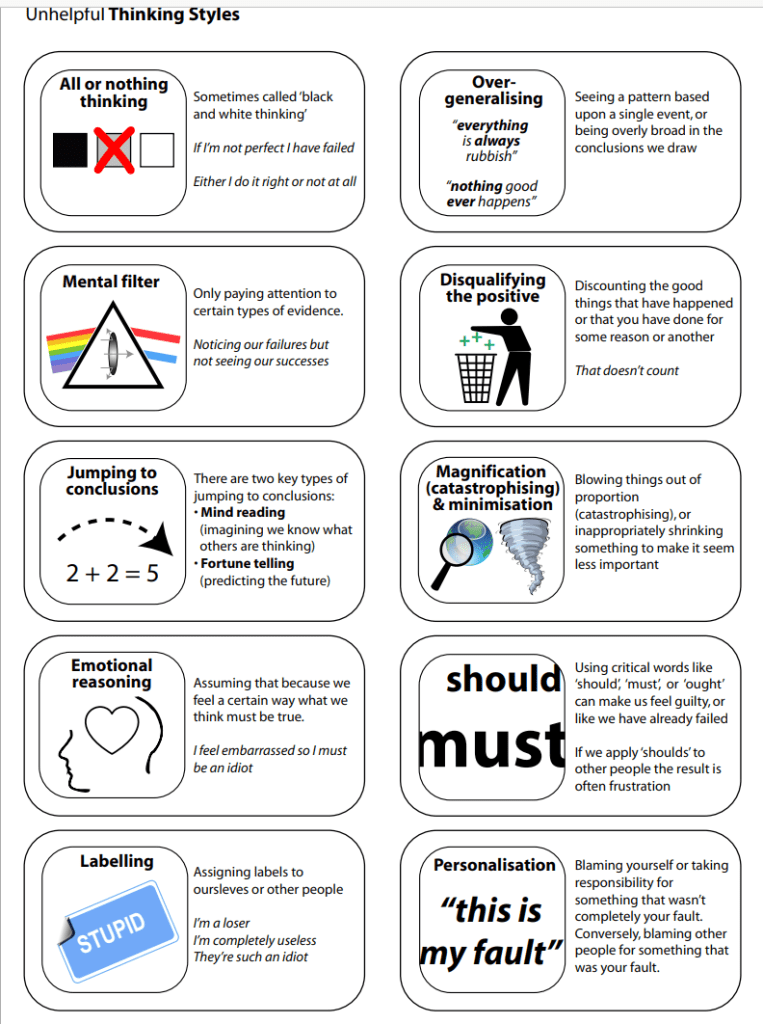
  • Cognitive Distortions

    A basic handout I have used with groups. Ideally I use handouts only to get a conversation going. The handout becomes a frame work for people to open up and start sharing.

    Cognitive Distortions and Strategies to dispute them

    • Personalizing: When you blame yourself entirely as the cause of something or blame someone else as the sole reason why something happens . “It’s my fault ” “It’s his/her fault.”
      Strategy: Don’t look for blame. Find other causes. List other possibilities.
    • All or nothing/black and white thinking: When you use extreme terms, “all”, “never”, “none”, “everybody”, “no one”. Also watch for “can’t”.
      Strategy: Look for gray areas. Modify your language by substituting less extreme terms such as “some”, “often”, “most”.
    • Catastrophizing: When you predict or expect the worst will happen.
      Strategy: Expect more positive outcomes and possibilities.
    • Should-ing: When you refer to (or rely on) your list of inflexible rules of acceptable behavior and believe you’re guilty or unworthy if you violate the rules. Or, when you get angry with others if they break the (your) rules. This results in “always having to be right “, or being “super human” or “perfect”.
      Strategy: Change your language: “I should/must” to “I’d prefer” or “I’d rather”.
    • Over-generalizing: When you make an overall assessment based on one example or incident.
      Strategy: Remember that no one situation can exactly predict future outcomes. Look for individuality in each case. Remember that possibilities may exist that have not existed before by recognizing that you have the ability to change, and that things are always changing.
    • Fallacy of fairness: When you expect things to work out based on some unseen system of “karma”, balance, morality, payback, justice, or what “should be fair”.
      Strategy: Change your expectations. There is no inherent system of fairness. Things can happen for no apparent reason.
    • Labeling/Name calling: When you attach powerful words or labels to yourself or others as if those words describe you, or them, or the situation completely. “This day is terrible”, or I’m stupid”.
      Strategy: Define the term, see if it is really accurate. Use only accurate terms. Avoid intense labeling and name-calling. Use less weighted, destructive or inflammatory words. Are you using a double standard? Are you judging yourself more harshly than others would judge you or than you would judge others?
    • Emotional reasoning: When you use your emotions or feelings as proof of how things are. “I feel so sad; things must be hopeless”.
      Strategy: Evaluate the evidence objectively. Feelings are not proof of how things are or will be. Recognize that emotions change.
    • Mind-reading: When you know what others are thinking and why they act the way they do. Particularly, you “know” how people think and feel about you.
      Strategy: Seek other explanations for why people behave the way they do. Don’t assume. Check it out. Ask for their thoughts, opinions and feedback. Remind yourself that you don’t know what they are thinking.
    • Disqualifying the positive: When you devalue anything “good” in a particular situation in light of the “bad”.
      Strategy: Make an accurate assessment. See that “negatives” or “shortcomings” don’t erase strengths and assets, but that these can co-exist.
    • Comparing: When you measure yourself against others, focusing on their accomplishments and attributes, or when you compare yourself to your own ideal.
      Strategy: One can’t compare apples and oranges. We’re all different with different qualities. We can usually find somebody who may be “better” in some way. So what? That doesn’t help. Focus on your own inherent worth and aspirations instead.