
The Holy Land is everywhere. Black Elk

Substance addiction is a perplexing phenomenon for those who fortunately do not suffer from it. Although it is incredible to believe that people would willfully engage in behaviors that create problems with their lives on so many levels, substance addiction is a reality for millions of people. According to data published by NIDA (National Institutes of Drug Abuse) nearly 20 million Americans have undergone opioid de-addiction therapy in 2010. What makes some people so susceptible to substance abuse while others are able to protect themselves? A study of brain images of heroin addicts, conducted by Gold, Liu and colleagues, shows significant differences in brain activity even in resting state, without heroin use. Functional MRI (fMRI) images from opioid addicted patients were compared with similar images from health people.
Resting state fMRI images of men undergoing opioid substitution therapy showed that areas of the brain engaged in reward perception, motivation, memory and self-control show significantly different activity than comparable regions in healthy individuals. Areas like the orbitofrontal cortex, cingulate gyrus and hippocampus show consistently different resting state activities in heroin-dependent and healthy subjects. The prefrontal cortex of dependent patients was less active than that of healthy patients in the resting state, during de-addiction therapy. However, this area which controls motivation as well as degree of inhibition, was observed to be highly active during periods of opioid use. Other areas of the brain like the hippocampus which regulates memory, also showed activity patterns that were different from those in healthy subjects, in the resting state in addicted individuals. These images shed light on the mechanism of addiction in people and the areas of the brain that are engaged, perhaps constitutively, in sustaining addiction.

Given that study participants were enrolled from de-addiction clinics, episodes of heroin abuse had already taken place in their life. It is unclear whether the same areas of the brain would show similar activity in naive individuals. If this possibility is validated by comparative studies, these fMRI imaging techniques may have tremendous diagnostic potential in identifying people who are at high risk for addiction. One drawback of this investigation is that only male patients were included in this study. Therefore, we do not know whether there are gender-based differences in the resting state brain activity of female opioid addicts.
The study does throw up interesting possibilities. It is possible to enroll naive subjects, possibly teenagers or pre-teens, and obtain baseline brain images before these people have tried out any addictive substance like tobacco, heroin or alcohol. Follow-up studies with the same people can indicate whether experience of addictive substances can change the baseline pattern of activity. This kind of long-term and long-range study may help to identify brain markers for specific addiction disorders. The study also indicates why counseling fails to have an impact on some patients. It is likely that profound changes in resting state brain activity resulting from addiction may override the effects of received and processed advice.
Reference
Zhang Y, Tian J, Yuan K, Liu P, Zhuo L, Qin W, Zhao L, Liu J, von Deneen KM, Klahr NJ, Gold MS, & Liu Y (2011). Distinct resting-state brain activities in heroin-dependent individuals. Brain research, 1402, 46-53 PMID: 21669407
Nature is infinitely creative. It is always producing the possibility of new beginnings. – Marianne Williamson

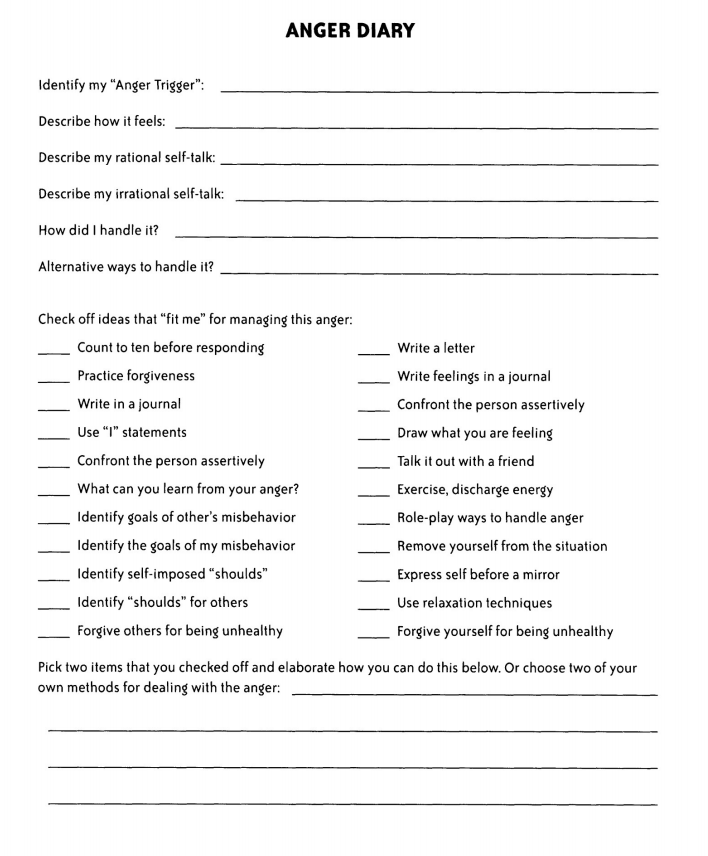
I spent years leading an anger management group and this handout was one I used when groups had difficulty engaging.
As in all groups at the end I asked people if this handout was useful or not and what could be done to make it better. Most said that it was somewhat useful. This handout was not my first choice in working with groups.

“The community today can be no single tradition; it is the planet. Daily the world grows smaller, leaving understanding the only place where peace can find a home.” Huston Smith
A basic handout I have used with groups. Ideally I use handouts only to get a conversation going. The handout becomes a frame work for people to open up and start sharing.
Cognitive Distortions and Strategies to dispute them


Do not wait for leaders; do it alone, person to person. Be faithful in small things because it is in them that your strength lies. Mother Teresa

 CreativeTherapyTools