

Tidy desk or messy desk?
Working at a clean and prim desk may promote healthy eating, generosity, and conventionality, according to new research. But, the research also shows that a messy desk may confer its own benefits, promoting creative thinking and stimulating new ideas.
The new studies, conducted by psychological scientist Kathleen Vohs and her fellow researchers at the University of Minnesota are published in Psychological Science, a journal of the Association for Psychological Science.
“Prior work has found that a clean setting leads people to do good things: Not engage in crime, not litter, and show more generosity,” Vohs explains. “We found, however, that you can get really valuable outcomes from being in a messy setting.”
In the first of several experiments, participants were asked to fill out some questionnaires in an office. Some completed the task in a clean and orderly office, while others did so in an unkempt one — papers were strewn about, and office supplies were cluttered here and there.
Afterward, the participants were presented with the opportunity to donate to a charity, and they were allowed to take a snack of chocolate or an apple on their way out.
Being in a clean room seemed to encourage people to do what was expected of them, Vohs explains. Compared with participants in the messy room, they donated more of their own money to charity and were more likely to choose the apple over the candy bar.
But the researchers hypothesized that messiness might have its virtues as well. In another experiment, participants were asked to come up with new uses for ping pong balls.
Overall, participants in the messy room generated the same number of ideas for new uses as their clean-room counterparts. But their ideas were rated as more interesting and creative when evaluated by impartial judges.
“Being in a messy room led to something that firms, industries, and societies want more of: Creativity,” says Vohs.
The researchers also found that when participants were given a choice between a new product and an established one, those in the messy room were more likely to prefer the novel one — a signal that being in a disorderly environment stimulates a release from conventionality. Whereas participants in a tidy room preferred the established product over the new one.
“Disorderly environments seem to inspire breaking free of tradition, which can produce fresh insights,” Vohs concludes. “Orderly environments, in contrast, encourage convention and playing it safe.”
Surprisingly, the specific physical location didn’t seem to matter: “We used 6 different locations in our paper — the specifics of the rooms were not important. Just making that environment tidy or unkempt made a whopping difference in people’s behavior,” says Vohs.
The researchers are continuing to investigate whether these effects might even transfer to a virtual environment: the Internet. Preliminary findings suggest that the tidiness of a webpage predicts the same kind of behaviors.
These preliminary data, coupled with the findings just published, are especially intriguing because of their broad relevance:
“We are all exposed to various kinds of settings, such as in our office space, our homes, our cars, even on the Internet,” Vohs observes. “Whether you have control over the tidiness of the environment or not, you are exposed to it and our research shows it can affect you.”
Co-authors on this research include Joseph Redden and Ryan Rahinel of the University of Minnesota. Redden discusses the new research in this video from the Carlson School of Management of the University of Minnesota.
K. D. Vohs, J. P. Redden, R. Rahinel. Physical Order Produces Healthy Choices, Generosity, and Conventionality, Whereas Disorder Produces Creativity. Psychological Science, 2013
Posted in creative arts therapy, lifespan, Self expression
1 Comment
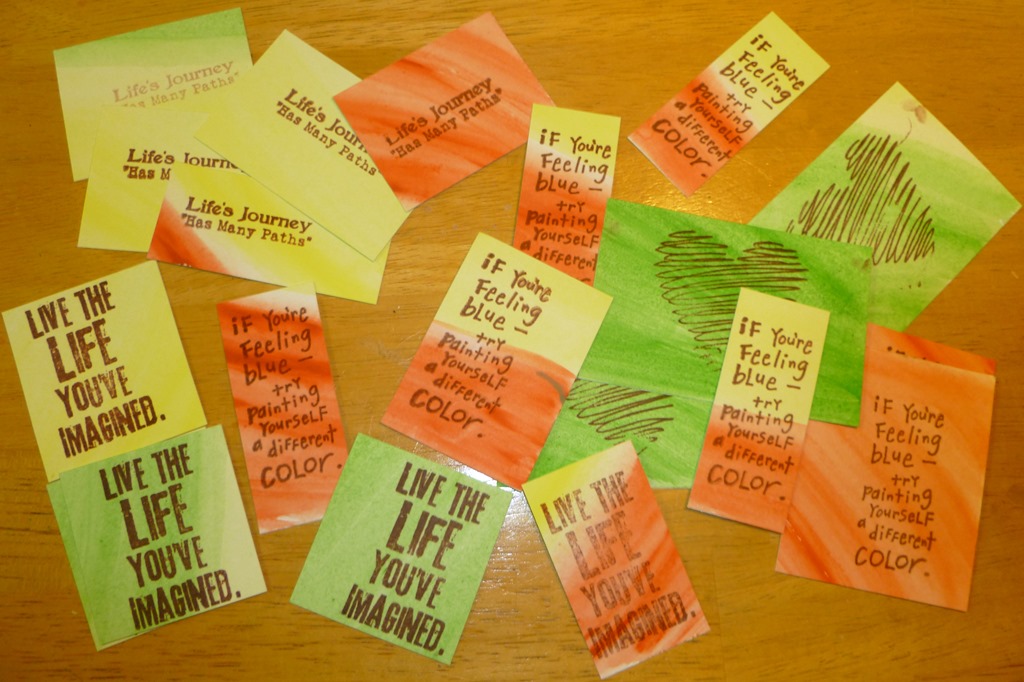
Therapy cards
One Creative Arts Therapy Tool that I use is to paint. Some times  pictures of actual ‘things’ like trees or boats; but I usually paint shapes. Lately I have been using water colors to paint shades and gradients of color. Colors shifting from one type of purple(for instance) to a deeper purple.
There is a lot going on in the simple act of painting color that involves cognitive processes, emotional expression, mindfulness practice, amongst others. There is the hand eye coordination, and the movement of the body (hand,arm shoulder), to apply the paint to the brush, water and paper. There is the picking and choosing of colors that I want to use; sometimes I pick a color that has a pleasing effect on how I feel, and sometimes that choice changes how I feel. The act of painting requires focus and at least a little concentration being in the here and now.
I have been turning my gradient paintings into therapy cards. I work a lot with groups providing therapy and often participants have difficulty expressing their feelings and/or thoughts. The cards provide an avenue for people to share/start a conversation. I have created affirmation cards, feelings cards, drama therapy cards, movement cards, yoga asana cards, and many others.
Jungian Archetypes
The Archetypes
Strictly speaking, Jungian archetypes refer to unclear underlying forms or the archetypes-as-such from which emerge images and motifs such as the mother, the child, the trickster and the flood amongst others. It is history, culture and personal context that shape these manifest representations giving them their specific content. These images and motifs are more precisely called archetypal images. However it is common for the term archetype to be used interchangeably to refer to both archetypes-as-such and archetypal images.
The Shadow
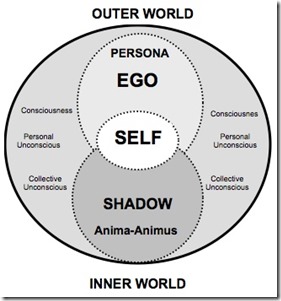
The most basic potential for patterning is the Shadow Archetype. This is the potential of experiencing the unconscious side of our unique personalities. As we move deeper into the dark side of our personality personal, identity begins to dissolve into “latent dispositions” common to all men. We experience the chaos which indicates that we are drawing close to the material structure of psychic life. This “Other Side” may be manifested in a wealth of images. The image of “wilderness” is fundamental. Remember that Hanzel and Gretel were led “into the woods” and were trapped. Knights discover dragons, ogres, and thieves in the woods. Robin Hood is at home in the wild. The image may be that of the mob and its underworld, an urban equivalent in which “Pretty Boy” Floyd is a hero. There is always “the concrete jungle.” Dragons sail the sea, “the watery wilderness.” Jesus and John the Baptist met God “in the wilderness,” as did Israel at Sinai.
The Shadow is the easiest of the archetypes for most persons to experience. We tend to see it in “others.” That is to say, we project our dark side onto others and thus interpret them as “enemies” or as “exotic” presences that fascinate. We see the Shadow everywhere in popular culture. He is Batman. She is Spider Woman. It is the Ninja Turtles. We see it in popular prejudice as well. We “imagine” that the Black Man is our enemy; that Communists are devils. We incline towards Hawaii as the “land of paradise.” We accept people uncritically if we perceive them as “Fair Haired.” Of course, Satan is the great Shadow image of popular religion (Consider: the word only occurs 54 times in the entire Bible.)
The Shadow is the personification of that part of human, psychic possibility that we deny in ourselves and project onto others. The goal of personality integration is to integrate the rejected, inferior side of our life into our total experience and to take responsibility for it.
 The Anima Or Animus
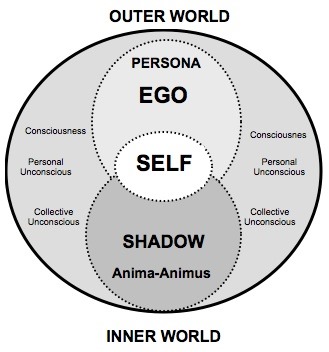
The second most prevalent potential patterning is that of the Soul (Anima is the male name for soul; Animus is the female name for soul). Here we meet our inner opposite. Males meet their Anima; females their Animus. The Anima may appear as an exotic dancing girl or a weathered old hag–the form generally reflects either the condition or the needs of our soul presently. Remember the wicked witch encountered by Hanzel and Gretel. The Animus may appear as an exotic, sensual, young man or as an old grouch. Remember the Great Oz who ran the Emerald City? There is always Simon Legree who took in Little Eva. Consider Super Man and Lois Lane. Clark Kent is the inferior, shadow side of Super Man, but he is also closer to ordinary people. Lois Lane has no interest in Clark. She is infatuated with Super Man, her Animus; the masculine completion of her personality. Wonder Woman offers us an example of the Anima in action.
The Syzygy (Divine Couple)
If one comes to terms with the Shadow and the Soul, one will encounter the enchanted castle with its King and Queen. This is a pattern of wholeness and integration. The opposites of the outer and the inner life are now joined in marriage. Great power arises from this integration. Christ and the Church, God and Israel are syzygy images. The believer who aspires to be the “bride of Christ” is modeling his or her experience in response to the syzygy archetype.
The Child
The Child Archetype is a pattern related to the hope and promise for new beginnings. It promises that Paradise can be regained. Child images like the New Year’s Babe obviously derive from this archetype. So do the golden ring and the golden ball and most flower and circle related images. The birth of the Christ Child who unites Heaven and Earth, Man and God, is a powerful archetypal event. Were the life of Jesus not interpreted by this archetype, it would lose most of its meaning. Jesus would just be one more teacher from the Hellenistic world.
The Self
The ultimate pattern is the Self. For Jung this is the God image. Human self and divine self are incapable of distinction. All is Spirit. Images of Spirit abound. Wind and breath being two very common ones. The Spirit descends as a Dove upon Jesus in the wilderness. The voice declares to him his true nature: “Your are my Son, my Beloved.” This is an archetypal drama of the Self. Galahad achieving the Grail and ascending with it to Heaven is likewise an archetypal drama of Self. Lancelot’s failure to achieve the Grail speaks of his failure to achieve the final discovery of Self. Chariots and cars point in this direction. Remember the death car which comes in Darby O’Gill and the Little People? Enoch is taken up in a chariot of fire. Ezekiel Chapter One describes the chariot conveying God into the world.
Posted in Jung, Mental Health, Psychoeducation, Psychotherapy
Tagged jung, Jungian archetypes, types
Leave a comment

 CreativeTherapyTools