
Grounding
Grounding Techniques are activities you use when you feel overwhelmed by feelings, thoughts, sensations. These techniques help a person move their focus away from what is overwhelming them to something else. That something else is preferable healthy and supportive to their wellbeing. Below is a list that clients and patients have mentioned over the years of things they do that help them ground.
- Get ice or ice water
- Breathe – slow and deep, like blowing up a balloon.
- Take your shoes off and rub your feet on the ground.
- Open your eyes and look around. See yourself in a different place than.
- Move around. Feel your body. Stretch out your arms, hands, fingers.
- Peel an orange or a lemon. Notice the smell. Take a bite. Focus on the taste.
- Pet your cat, dog or rabbit.
- Spray yourself with favorite perfume.
- Eat ice cream! Or any favorite food. Pay attention to the taste.
- Call a friend.
- Take a shower.
- Take a bath.
- Go for a walk. Feel the sunshine (or rain, or snow!)
- Count nice things.
- Dig in the dirt in your garden.
- Turn lights on.
- Play your favorite music.
- Hug a tree!
- Touch things around you.
- Frozen Orange – put your nails into it – the cold and the smell can bring you back
- Pull up the daily newspaper on your browser. Notice the date and read a current article.
- Stomp your feet to remind yourself where you are. Press your feet firmly into the ground.
- Try to notice where you are, your surroundings including people, sounds like the t.v. or radio.
- Concentrate on your breathing. Take a deep cleansing breath from your diaphragm. Count the breaths as you exhale. Make sure you breath slowly so you don’t hyperventilate.
- Cross your legs and arms. Feel the sensations of you controlling your body.
- Call a friend and ask them to talk with you about something you have recently done together.
- Take a warm relaxing bubble bath or a warm shower. Feel the water touching your body.
- Mentally remind yourself that the memory was then, and it is over. Give yourself permission to not think about it right now.
- Realize that no matter how small you feel, you are an adult.
- Go outside and sit against a tree. Feel the bark pressing against your body. Smell the outside aromas like the grass and the leaves. Run your fingers through the grass.
- If you are sitting, stand. If you are standing sit. Pay attention to the movement change. Reminding yourself — you are in control.
- Rub your palms, clap your hands. Listen to the sounds. Feel the sensation.
- Speak out loud. Say your name or significant others name.
- Hold something that you find comforting, for some it may be a stuffed animal or a blanket. Notice how it feels in your hands. Is it hard or soft?
- Eat something. How does it taste, sweet or sour? Is it warm or cold?
- If you have a pet use that moment to touch them. Feel their fur and speak the animals name out loud.
- Visualize a bright red STOP sign to help you stop the flashback and/or memory
- Step outside. If it’s warm, feel the sun shining down on your face. If it’s cold, feel the breeze. How does it make your body feel?
- Take a walk outside and notice your neighborhood. Pay attention to houses and count them.
- Listen to familiar music and sing along to it. Dance to it.
- Write in your journal. Pay attention to yourself holding the pencil. Write about what you are remembering and visualize the memory traveling out of you into the pencil and onto the paper. Tear the paper up or seal it in an envelope. Give it to your therapist for safekeeping.
- Go online and talk with an online friend. Write an email.
- Imagine yourself in a safe place. Feel the safety and know it.
- Watch a favorite t.v. program or video. Play a video game.
- If you have a garden, work in it. Feel your hands running through the dirt.
- Wash dishes or clean your house.
- Meditate if you are comfortable with it.
- Exercise. Ride a bike, stationary or otherwise. Lift weights. Do jumping jacks.
Posted in Wellness
Leave a comment

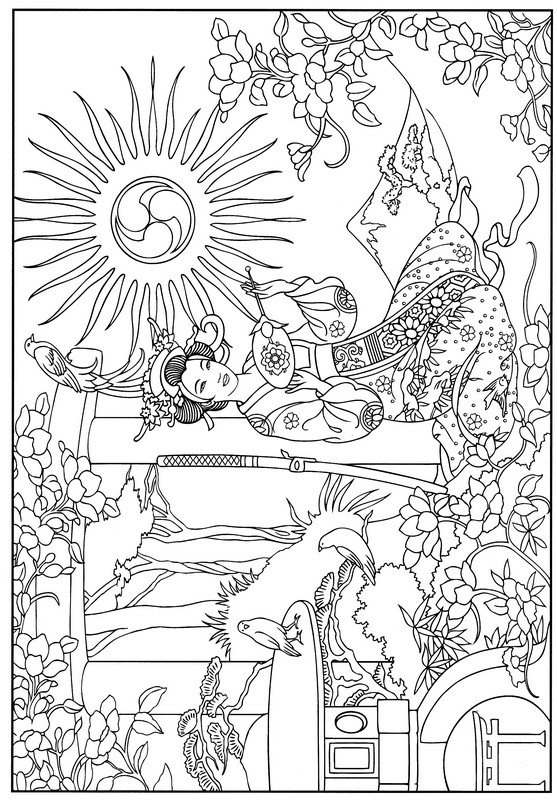
Amaterasu Coloring Page
Amaterasu, Amaterasu-ōmikami or Ōhirume-no-muchi-no-kami is a part of the Japanese myth cycle and also a major deity of the Shinto religion. She is seen as the goddess of the sun, but also of the universe. The name Amaterasu derived from Amateru meaning “shining in heaven.” The meaning of her whole name,Amaterasu-ōmikami, is “the great august kami (god) who shines in the heaven”.
https://en.wikipedia.org/wiki/Amaterasu
Experience is embodied
“We only believe those thoughts which have been conceived not in the brain but in the whole body.” W.B. Yeats
This quote reminds me of a book by George Lakoff and Mark Johnson who presented an opinion that the mind is ‘embodied,’ and our mental capacities, such as categorization and metaphor, grow out of bodily experience. They believe we build up complex representations of the world out of basic level categories (of objects, actions, emotions, social concepts, and so on). These basic level concepts result from bodily experience in the world in which we move, eat, sleep, experience and live.
For example, Lakoff and Johnson report that spatial relations concepts ‘are at the heart of our conceptual system.’ Examples of such concepts are the Container Schema, the Source-Path-Goal Schema, and bodily projections (such as above-below, in front-behind). The body itself is experienced as a container, with an inside and an outside, and we project this experience of ‘container like-ness’ onto other people and objects (a car, a building).
The child gains a bodily experience of these schemata from the first moments after birth when he/she (a) moves to the breast (Source-Path-Goal) and (b) opens and closes the mouth around the nipple, sucking in the milk (Container). In fact, infants have a habit of putting almost anything they can get their hands on into their mouths. In this way they learn the differences between inside and outside, ‘me’ and ‘not-me’. Later the infant learns to crawl towards objects in space as well as to stand, walk and run, all of which give new experiences of the ‘Spatial Self ‘.
One of the primary developmental tasks of the first year of life is achieving a sense of the wholeness of one’s own body, achieving a relationship to space (objects in the space above the crib; mother who comes and goes…). The basic cognitive elements of thought derive from bodily experiences before the emergence of spoken language.
Lakoff, George and Johnson, Mark (1999) Philosophy In The Flesh: the Embodied Mind and its Challenge to Western Thought. Basic Books.
Lakoff, George (1987) Women, Fire, and Dangerous Things: What Categories Reveal About the Mind. University of Chicago Press


 CreativeTherapyTools