
-
Eastern Wood Pewee Coloring Page

-
foot

Dancing is the poetry of the foot. John Dryden
-
Coloring page hummingbird

-
Watch: How does touch affect our mental and physical health? | DW Documentary
-
Coloring page town

-
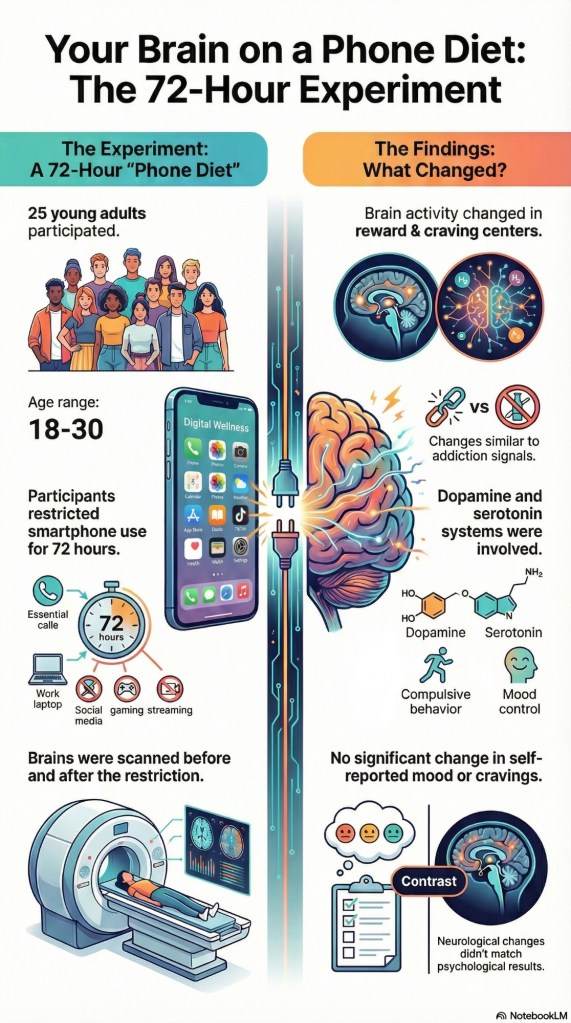
3 Days Can Reshape Your Brain by not using your phone
Interesting article from ScienceAlert.
Link to article: https://www.sciencealert.com/giving-up-your-phone-for-just-3-days-can-reshape-your-brain-activity
Researchers from German universities investigated 25 young adults who limited their phone use to essential tasks for 72 hours, using MRI scans and psychological tests before and after the restriction period. The core finding was that images of smartphones after the restriction triggered changes in brain regions associated with reward processing and cravings, similar to patterns observed in substance addictions. These neural changes were specifically linked to dopamine and serotonin systems, supporting the hypothesis that excessive smartphone use can be addictive. Although brain activity showed these changes, the psychological tests did not register significant changes in the participants’ mood or reported cravings during the brief period of restriction.
-
Watch: Neurologists Debunk 11 Brain Myths | Debunked | Science Insider
-
the social fabric
We all participate in weaving the social fabric; we should therefore all participate in patching the fabric when it develops holes. Anne C. Weisberg

-
like snow
A lot of people like snow. I find it to be an unnecessary freezing of water. Carl Reiner

-
Embracing your words
When I work with groups I am constantly observing and evaluating. I use evaluations to guide and direct; to ascertain the problems and needs of the group, and program. According to Cruz, Berrol, (2004), “…quantitative methods explore measurable observable phenomena related to human experience, and seeks to explain and predict behavior.”
For instance, in one particular group I observed a client clench her hands, contract, and stand in a posture that would be difficult to move from whenever she used the phrase, “moving forward.” My hypothesis: she did not embody and perhaps didn’t truly believe and embrace what she was saying. There was clear and physical tension around this phrase for her.

I have observed countless times before, the relationship between words and phrases and stances and postures (known behavioral phenomenon). Further, I have witnessed how one could change one part, stances/postures for instance (known variable), which would change the manner of the spoken words/phrases and thus their meaning for the client (predicted state). Based on this data, I suggested the client consciously take a stance/posture that was physically non-contracting (opening), and begin a movement process that was opening and flowing. Her body stance/posture changed and the manner in which she said her words changed as she experienced the concept of ‘moving forward’ on a variety of levels.
Afterwards, she shared that she began to truly believe both physically and emotionally that she could ‘move forward.’ My assertion that she did not fully embrace what she was saying was confirmed by the client.
This particular example occurred in the mid 1980’s. I used my training in the ‘Halprin Method’, and experience as a mover to offer suggestions of embodiment and embracing.

 CreativeTherapyTools