
-
How The Brain Maintains Memories
A team of neuroscientists at the University of Toronto in Canada has discovered a reason why we often struggle to remember small details of past experiences.
Many events in our lives resemble experiences we have had before, without being identical to them.
Whenever you attend a party, for example, you may well take along a gift, such as a bottle of wine or a box of chocolates, but the gift will differ on each occasion.
Researchers believe that as our memories for such events become older, the incidental details unique to each event (such as the identity of the gift) are mostly forgotten.
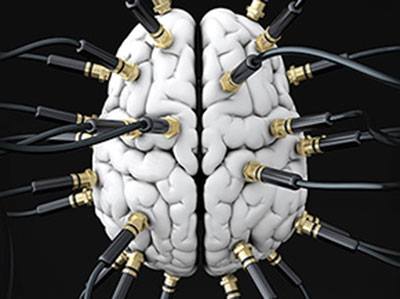
However, the common underlying patterns (what parties are like in general) are retained. This allows us to accumulate knowledge to guide our behavior in similar situations in the future.
Studies in rodents and people have shown that a region of the brain called the medial prefrontal cortex (mPFC) stores long-term memories about experiences.
But to what extent do neurons in this region represent abstract generalized knowledge as opposed to the specific incidental details?
“Memories of recent experiences are rich in incidental detail but, with time, the brain is thought to extract important information that is common across various past experiences,” said Dr. Kaori Takehara-Nishiuchi, senior author of the study.
“We predicted that groups of neurons in the mPFC build representations of this information over the period when long-term memory consolidation is known to take place, and that this information has a larger representation in the brain than the smaller details.”
To test their prediction, Dr. Takehara-Nishiuchi and her colleagues studied how two different memories with overlapping associative features are coded by neuron groups in the mPFC of rat brains, and how these codes change over time.
Rats were given two experiences with an interval between each: one involving a light and tone stimulus, and the other involving a physical stimulus. This gave them two memories that shared a common stimulus relationship.
The researchers then tracked the neuron activity in the animals’ brains from the first day of learning to four weeks following their experiences.
“This experiment revealed that groups of neurons in the mPFC initially encode both the unique and shared features of the stimuli in a similar way,” said Mark Morrissey, first author on the study.
“However, over the course of a month, the coding becomes more sensitive to the shared features and less sensitive to the unique features, which become lost.”
Further experiments also revealed that the brain can adapt the general knowledge gained from multiple experiences immediately to a new situation.
“This goes some way to answering the long-standing question of whether the formation of generalized memory is simply a result of the brain’s network ‘forgetting’ incidental features,” Morrissey said.
“On the contrary, we show that groups of neurons develop coding to store shared information from different experiences while, seemingly independently, losing selectivity for irrelevant details.”
“The unique coding property of the mPFC identified in the study may support its role in the formation, maintenance, and updating of associative knowledge structures that help support flexible and adaptive behavior in rats and other animals,” he said.
-
conformity

How I hate those who are dedicated to producing conformity. William S. Burroughs
-
Emotional Self-Control and the Brain
Different brain areas are activated when we choose to suppress an emotion, compared to when we are instructed to inhibit an emotion, according a new study from the UCL Institute of Cognitive Neuroscience and Ghent University.
In this study, published in Brain Structure and Function, the researchers scanned the brains of healthy participants and found that key brain systems were activated when choosing for oneself to suppress an emotion. They had previously linked this brain area to deciding to inhibit movement.

“This result shows that emotional self-control involves a quite different brain system from simply being told how to respond emotionally,” said lead author Dr Simone Kuhn (Ghent University).
In most previous studies, participants were instructed to feel or inhibit an emotional response. However, in everyday life we are rarely told to suppress our emotions, and usually have to decide ourselves whether to feel or control our emotions.
In this new study the researchers showed fifteen healthy women unpleasant or frightening pictures. The participants were given a choice to feel the emotion elicited by the image, or alternatively to inhibit the emotion, by distancing themselves through an act of self-control.
The researchers used functional magnetic resonance imaging (fMRI) to scan the brains of the participants. They compared this brain activity to another experiment where the participants were instructed to feel or inhibit their emotions, rather than choose for themselves.
Different parts of the brain were activated in the two situations. When participants decided for themselves to inhibit negative emotions, the scientists found activation in the dorso-medial prefrontal area of the brain. They had previously linked this brain area to deciding to inhibit movement.
In contrast, when participants were instructed by the experimenter to inhibit the emotion, a second, more lateral area was activated.
“We think controlling one’s emotions and controlling one’s behavior involve overlapping mechanisms,” said Dr Kuhn.
“We should distinguish between voluntary and instructed control of emotions, in the same way as we can distinguish between making up our own mind about what do, versus following instructions.”
Regulating emotions is part of our daily life and is important for our mental health. For example, many people have to conquer fear of speaking in public, while some professionals such as health-care workers and firemen have to maintain an emotional distance from unpleasant or distressing scenes that occur in their jobs.
Professor Patrick Haggard (UCL Institute of Cognitive Neuroscience) co-author of the paper said the brain mechanism identified in this study could be a potential target for therapies.
“The ability to manage one’s own emotions is affected in many mental health conditions, so identifying this mechanism opens interesting possibilities for future research.
“Most studies of emotion processing in the brain simply assume that people passively receive emotional stimuli, and automatically feel the corresponding emotion. In contrast, the area we have identified may contribute to some individuals’ ability to rise above particular emotional situations.
“This kind of self-control mechanism may have positive aspects, for example making people less vulnerable to excessive emotion. But altered function of this brain area could also potentially lead to difficulties in responding appropriately to emotional situations.”
-
Trees
Trees are the earth’s endless effort to speak to the listening heaven. Rabindranath Tagore

-
Big Five Crazy Beliefs
When we think (and strongly believe!) crazy stuff, really irrational stuff, we are most likely thinking one or more of the following:
- “Things should (ought, must, have to) be different than they are!”
- “It’s awful (horrible, terrible, catastrophic) that they aren’t!”
- “I can’t stand it (it’s too long, too much, too big, too painful)!”
- “Somebody here is a jerk!”
- “Because I have failed, I’ll always fail!”
Sure, there are other possible irrational statements, but these are among the most frequent, I believe; these are the big five. They represent “must”, “awfulizing”, “low frustration tolerance (LFT)”, and “condemning” beliefs.
A fellow maniac of the freeways cuts you off at the pass. You flip into overdrive rage: “Hey, jerk!” “You learn to drive in your living room (translation: He shouldn’t drive like that)?” “That’s the way to get people killed (translation: That’s awful)!” “I can’t stand drivers like that (translation: I can’t stand driver’s like that)!” You only needed three of the five crazy beliefs here.
I find these five statements are frequently part of the irrational thinking that gets people in trouble. If you work diligently to get rid these irrational beliefs, you will find your life more peaceful, even though you will still face life’s difficulties.
If you have a little difficulty seeing that you believe these crazy ideas, just pay attention to what goes through your mind when you feel upset. That’s the way it sometimes is with “new thinking;” we need a little time and pushing to catch it. Be patient with yourself, and you’ll catch on, too.
-
Land
The Holy Land is everywhere. Black Elk
-
Opioid Addiction – Brain Functions
Substance addiction is a perplexing phenomenon for those who fortunately do not suffer from it. Although it is incredible to believe that people would willfully engage in behaviors that create problems with their lives on so many levels, substance addiction is a reality for millions of people. According to data published by NIDA (National Institutes of Drug Abuse) nearly 20 million Americans have undergone opioid de-addiction therapy in 2010. What makes some people so susceptible to substance abuse while others are able to protect themselves? A study of brain images of heroin addicts, conducted by Gold, Liu and colleagues, shows significant differences in brain activity even in resting state, without heroin use. Functional MRI (fMRI) images from opioid addicted patients were compared with similar images from health people.
Resting state fMRI images of men undergoing opioid substitution therapy showed that areas of the brain engaged in reward perception, motivation, memory and self-control show significantly different activity than comparable regions in healthy individuals. Areas like the orbitofrontal cortex, cingulate gyrus and hippocampus show consistently different resting state activities in heroin-dependent and healthy subjects. The prefrontal cortex of dependent patients was less active than that of healthy patients in the resting state, during de-addiction therapy. However, this area which controls motivation as well as degree of inhibition, was observed to be highly active during periods of opioid use. Other areas of the brain like the hippocampus which regulates memory, also showed activity patterns that were different from those in healthy subjects, in the resting state in addicted individuals. These images shed light on the mechanism of addiction in people and the areas of the brain that are engaged, perhaps constitutively, in sustaining addiction.

Given that study participants were enrolled from de-addiction clinics, episodes of heroin abuse had already taken place in their life. It is unclear whether the same areas of the brain would show similar activity in naive individuals. If this possibility is validated by comparative studies, these fMRI imaging techniques may have tremendous diagnostic potential in identifying people who are at high risk for addiction. One drawback of this investigation is that only male patients were included in this study. Therefore, we do not know whether there are gender-based differences in the resting state brain activity of female opioid addicts.
The study does throw up interesting possibilities. It is possible to enroll naive subjects, possibly teenagers or pre-teens, and obtain baseline brain images before these people have tried out any addictive substance like tobacco, heroin or alcohol. Follow-up studies with the same people can indicate whether experience of addictive substances can change the baseline pattern of activity. This kind of long-term and long-range study may help to identify brain markers for specific addiction disorders. The study also indicates why counseling fails to have an impact on some patients. It is likely that profound changes in resting state brain activity resulting from addiction may override the effects of received and processed advice.
Reference
Zhang Y, Tian J, Yuan K, Liu P, Zhuo L, Qin W, Zhao L, Liu J, von Deneen KM, Klahr NJ, Gold MS, & Liu Y (2011). Distinct resting-state brain activities in heroin-dependent individuals. Brain research, 1402, 46-53 PMID: 21669407
-
Nature
Nature is infinitely creative. It is always producing the possibility of new beginnings. – Marianne Williamson

-
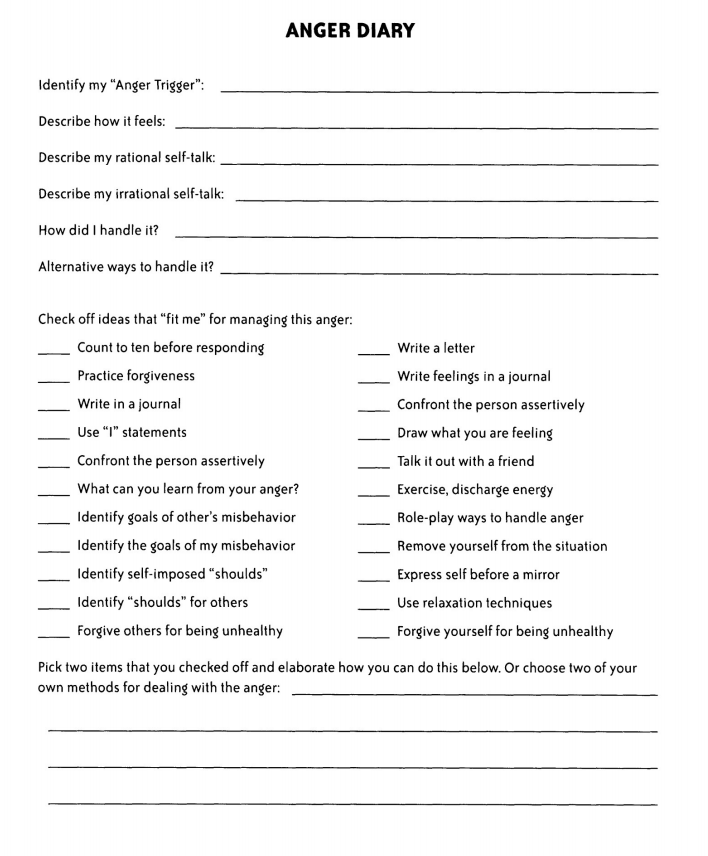
Anger Diary Handout
I spent years leading an anger management group and this handout was one I used when groups had difficulty engaging.
As in all groups at the end I asked people if this handout was useful or not and what could be done to make it better. Most said that it was somewhat useful. This handout was not my first choice in working with groups.
-
The community

“The community today can be no single tradition; it is the planet. Daily the world grows smaller, leaving understanding the only place where peace can find a home.” Huston Smith


 CreativeTherapyTools